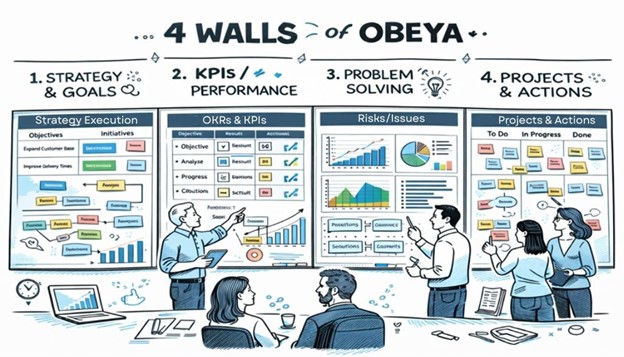
Balanced Scorecard Implementation Approach
Overview
Rescon Partners helps organizations translate strategy into disciplined, measurable execution using the Balanced Scorecard framework. Our approach goes beyond KPI design to establish the Balanced Scorecard as a closed-loop strategic management system that links strategy articulation, execution, review, and learning.
This is a generic implementation approach. As we develop a deeper understanding of your organization, industry, and strategic context, elements of this approach may be refined.
Balanced Scorecard: Strategic Intent
The Balanced Scorecard, developed by Dr. Robert Kaplan and Dr. David Norton, is one of the world’s most widely adopted strategy execution frameworks. At Rescon Partners, we view the Balanced Scorecard not as a measurement tool, but as a leadership-driven strategy execution system.
It translates long-term strategic intent into a coherent set of objectives, measures, targets, and initiatives across four perspectives:
- Financial – How the organization creates sustainable economic value
- Customer / Stakeholder – How value is delivered to customers, partners, and stakeholders
- Internal Processes – The processes that enable strategic differentiation and efficiency
- Organizational Capacity – People, culture, systems, and capabilities required for long-term success
By integrating these perspectives, the Balanced Scorecard connects long-term ambition with day-to-day execution and enables disciplined strategy reviews and course correction.
When a Phase 0 Strategy Articulation Workshop Is Required
Balanced Scorecard is a strategy execution system — it does not substitute for strategy.
In many organizations, strategy exists implicitly within the leadership team but is not explicitly articulated or written down. To address this, Rescon Partners may recommend a one-day Strategy Articulation Workshop (Phase 0) prior to commencing Balanced Scorecard implementation.
This workshop helps leadership teams:
- Make the existing strategy explicit
- Resolve differences in interpretation
- Force strategic choices and trade-offs
- Establish clear strategy themes
The output becomes the foundation for the Strategy Map and Enterprise Balanced Scorecard.
Scope of a Typical Balanced Scorecard Engagement
A standard engagement includes:
- Leadership diagnostic through structured CXO interviews
- Strategy articulation support (where required)
- Enterprise Strategy Map and Balanced Scorecard design
- KPI definition, standardization, and governance setup
- Balanced Scorecard automation using IMPACT or equivalent tools
- Cascading scorecards to business units and functions
- Monthly strategy review facilitation and stabilization
Our Implementation Journey
Rescon Partners follows a structured, end-to-end Balanced Scorecard implementation journey designed to embed strategy execution discipline while building internal capability.
Where required, the journey is preceded by a Phase 0 Strategy Articulation Workshop to ensure that the Balanced Scorecard is anchored in a clearly articulated and shared strategy.
Phase 1: Leadership Diagnostic and Readiness Assessment (One Week)
We begin with one-on-one interviews with senior leaders to assess strategy clarity, leadership alignment, decision-making culture, data maturity, and organizational readiness. Execution risks and change management challenges are surfaced early.
Outcome: Clear view of readiness, risks, and value-creation logic.
Phase 2: Leadership Alignment and Capability Building (One Day)
A facilitated leadership workshop introduces the Balanced Scorecard as a strategy execution system. The focus is on shared understanding, strategic trade-offs, cause-effect thinking, and identification of enterprise-level strategy themes.
Outcome: Leadership alignment and agreement on strategy themes.
Phase 3: Strategy Map and Enterprise Scorecard Design (Two Days)
Through a structured working session, leadership teams design the enterprise Strategy Map and Balanced Scorecard. Strategic objectives, cause-effect linkages, KPIs, targets, initiatives, ownership, and budgets are agreed.
Data perfection is not required at this stage; measures mature over time.
Outcome: A complete Strategy Map and Enterprise Balanced Scorecard.
Phase 4: Automation and Data Enablement
Balanced Scorecards are automated using IMPACT (by Spider Strategies) or a client-preferred platform. Automation ensures consistency, transparency, governance, and real-time visibility.
This phase includes KPI definitions, data ownership, dashboards, and reporting structures.
Phase 5: Cascading to Business Units and Functions
Enterprise objectives are cascaded through structured workshops with business units and functions. Unit scorecards remain aligned to enterprise strategy while reflecting local accountability and operational realities.
Phase 6: Strategy Review, Stabilization, and Handover
Rescon Partners facilitates initial strategy review cycles, coaching leaders to use the Balanced Scorecard as the primary management agenda. KPIs and initiatives are refined, and internal teams are enabled to sustain the system independently.
Key Success Factors
- Strategy-first orientation
- Visible and sustained leadership commitment
- Clear communication and change management
- Limited, focused measures linked to strategy
- Balanced mix of leading and lagging indicators
- Automation-enabled transparency
- Regular, learning-oriented strategy reviews
Common Reasons Balanced Scorecard Fails
- Weak or inconsistent leadership ownership
- Treating the Balanced Scorecard as a KPI exercise
- Fear-based performance management culture
- Measuring what is easy instead of what matters
- Irregular or presentation-heavy review meetings
- Inadequate data and reporting systems
Timeline
A typical Balanced Scorecard implementation spans three to six months, depending on organizational readiness. Most organizations begin to see tangible impact by the third or fourth strategy review cycle.
The Team
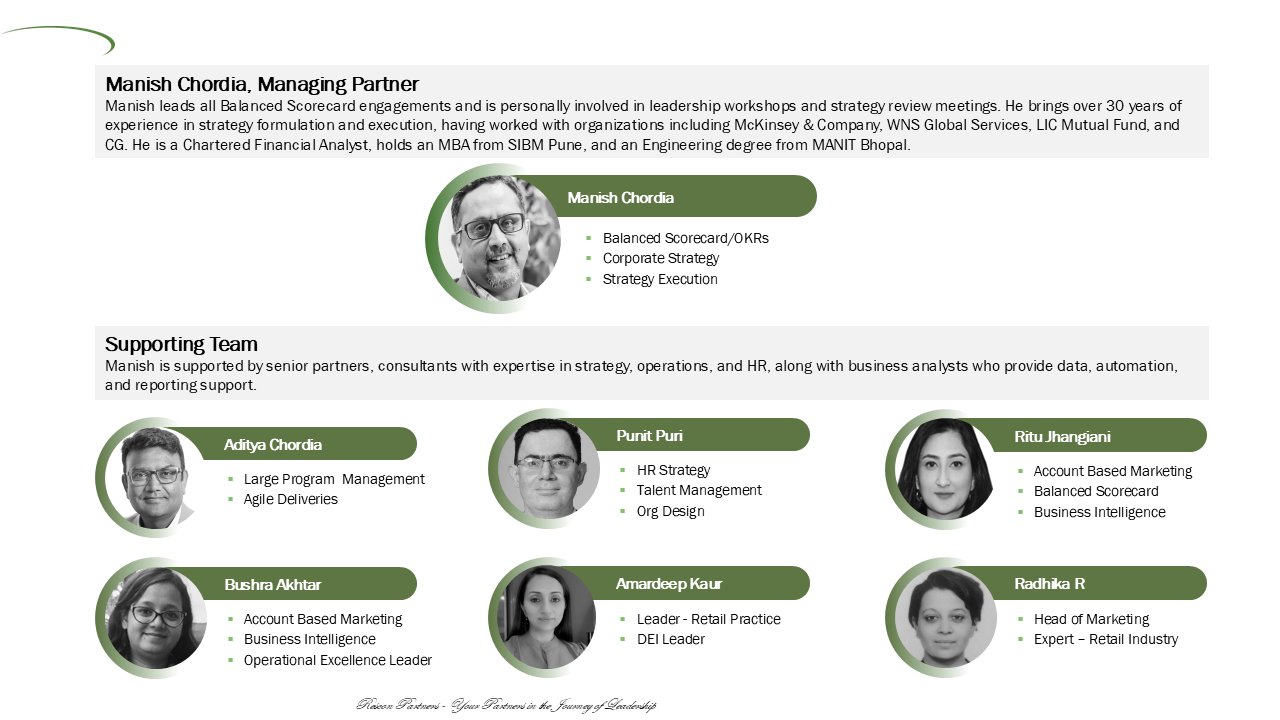

Ritu specializes in “Go-to-Client” strategic engagements, collaborating with top-tier technology companies featured in the Gartner Magic Quadrant. She brings a deep understanding of multiple industries and global markets, with a strong focus on market assessments, competitive analysis, uncovering white space opportunities, and monitoring disruptive technologies and industry trends.