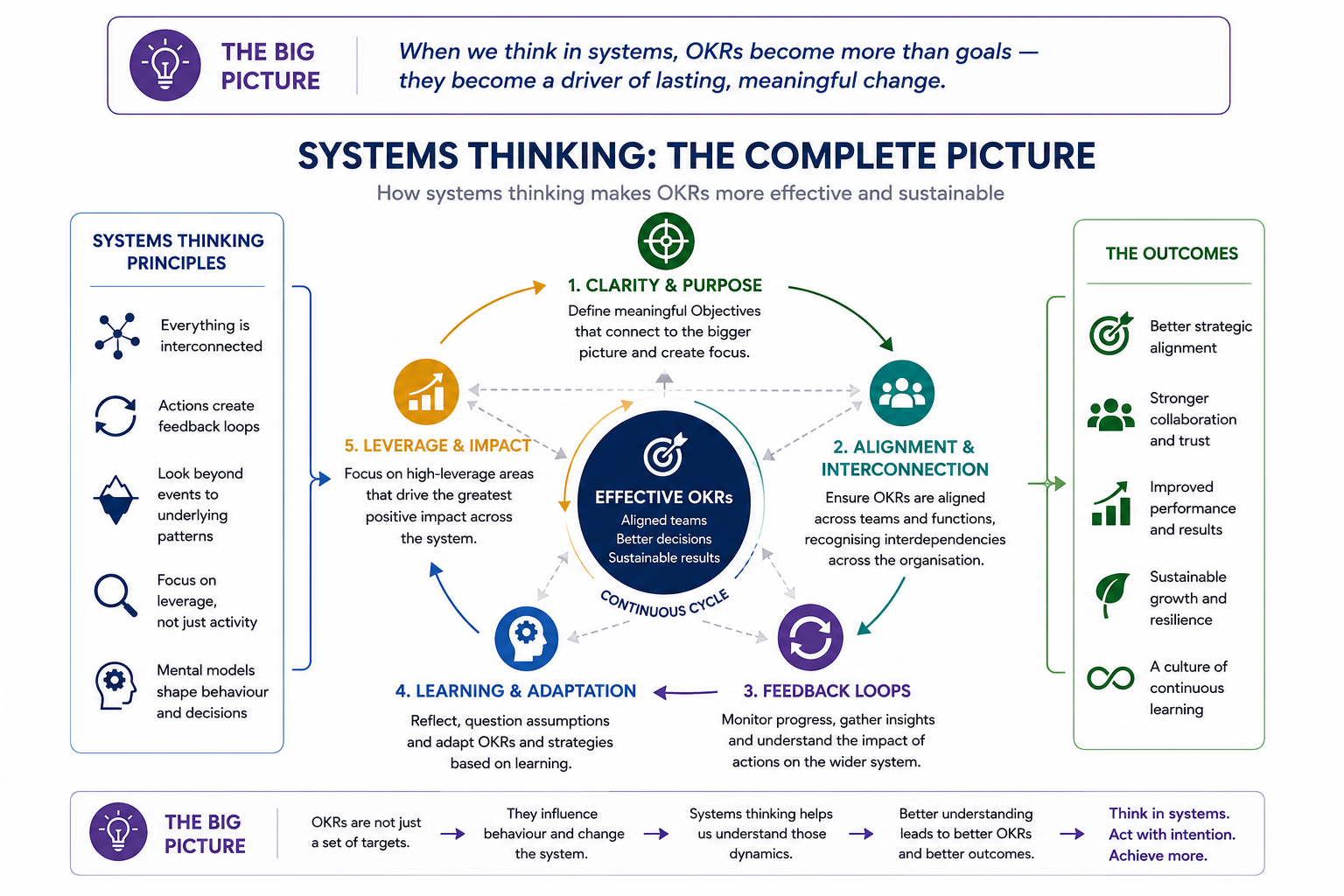
Systems Thinking for Successful OKR Implementation
Objectives and Key Results (OKRs) have become one of the most widely adopted frameworks for translating strategy into measurable outcomes. Popularized by Andy Grove at Intel and later championed by John Doerr, OKRs provide organizations with a structured approach to setting ambitious goals while maintaining alignment and accountability. Yet despite their simplicity, many OKR implementations fail to deliver lasting improvements. A recurring reason is that organizations treat OKRs as an isolated performance management tool rather than as part of a wider organizational system. Systems thinking offers a fundamentally different perspective. Instead of focusing on individual targets, it examines the relationships, feedback loops, incentives and structures that collectively determine organizational performance. This article argues that systems thinking is not simply complementary to OKRs but is a prerequisite for their successful implementation.
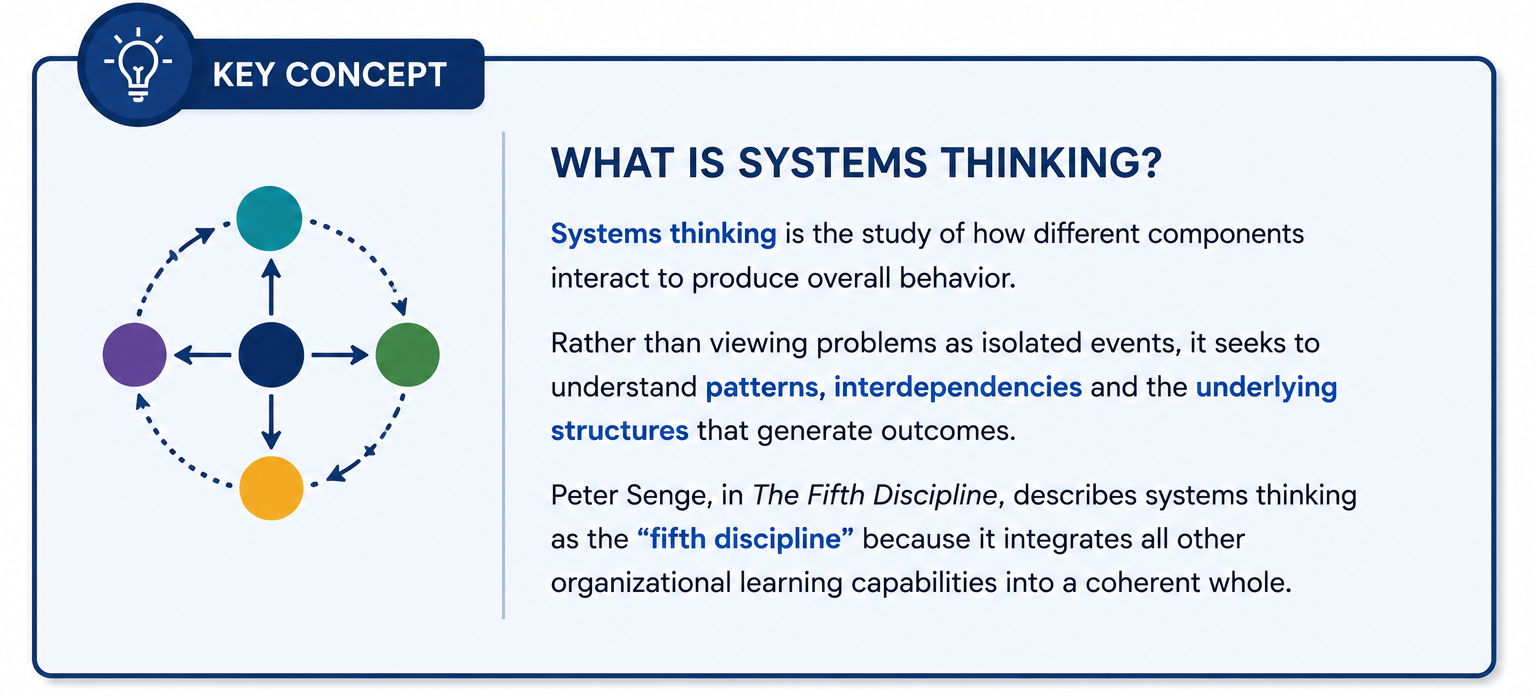
The relevance of systems thinking to OKRs becomes clear when recognizing that organizations are complex adaptive systems, made up of many connected parts that constantly influence one another. Because of these connections, changing one part of the organization often creates unexpected effects elsewhere. Objectives are rarely achieved by one individual or department acting independently. Instead, success emerges from the coordinated interaction of people, processes, technology, governance and organizational culture. Consequently, implementing OKRs without understanding these interactions risks optimizing individual components while degrading overall system performance.
The Limitations of Linear Thinking
Traditional management often assumes a simple relationship between effort and results: set a target, assign ownership and measure performance. While this approach works for straightforward tasks, organisations rarely operate in such a predictable way because different teams and functions constantly influence one another.
Russell Ackoff, one of the pioneers of systems thinking, argued that improving individual parts of a system does not necessarily improve the performance of the whole. In some cases, it can actually make overall performance worse.
For example, a customer service team may introduce an OKR to reduce average call handling time. Although this Key Result is achieved, advisors may spend less time resolving customer issues properly, leading to repeat calls and lower customer satisfaction. The team’s performance appears to improve, but the overall customer experience deteriorates. The problem is not the OKR itself, but the failure to consider how one team’s actions affect the wider organisational system.
Understanding Feedback Loops
One of the central ideas in systems thinking is that actions rarely produce a single, isolated outcome. Instead, they create feedback loops, where the results of one action influence future behaviour and performance.
For example, imagine an organisation introduces OKRs to improve collaboration between departments. Teams begin sharing information more regularly, communication improves and projects are delivered more successfully. Those positive results increase confidence in the OKR process, encouraging even greater collaboration during future planning cycles. This is known as a reinforcing feedback loop, where positive behaviours strengthen over time.
The opposite can also occur. If leaders introduce highly ambitious OKRs without considering available capacity, employees may experience increased workload and stress. Collaboration begins to decline, performance falls and leaders respond by applying even more pressure to meet targets. This creates a balancing feedback loop, where the system naturally resists improvement.
Donella Meadows explains that recognising these feedback loops allows organisations to understand not only whether an Objective has been achieved, but also how pursuing that Objective changes the wider organisational system over time.
Alignment Beyond Cascading Objectives
Many organisations assume that OKR alignment simply means cascading objectives from senior leadership to departments and individual teams. While this creates clarity, systems thinking suggests that genuine alignment comes from understanding how teams depend on one another.
John Doerr, in Measure What Matters, highlights the importance of transparency and cross-functional collaboration. Systems thinking builds on this idea by encouraging teams to identify shared processes, dependencies and constraints before defining Objectives.
This shifts the conversation from “What should my team achieve?” to “How does our work influence the long-term health and performance of the wider organisation?”
For example, a sales team may have an Objective to increase customer acquisition, while operations focuses on improving service quality. Rather than pursuing these goals independently, systems thinking encourages both teams to understand how their Objectives influence one another, creating stronger alignment across the organisation.
Learning Rather Than Controlling
OKRs are often viewed as a way of measuring performance. However, systems thinking suggests they should also be viewed as a mechanism for organisational learning.
Chris Argyris distinguishes between single-loop learning and double-loop learning. Single-loop learning focuses on improving actions to achieve existing goals. Double-loop learning goes a step further by questioning whether the goals, assumptions and organisational processes are appropriate in the first place.
For example, if an organisation repeatedly misses a Key Result, the immediate response may be to allocate more resources or monitor performance more closely. Systems thinking instead asks deeper questions. Are the right people involved? Are incentives encouraging the desired behaviours? Is the process itself creating unnecessary barriers?
By asking these questions, quarterly OKR reviews become opportunities for learning and continuous improvement rather than simply measuring success or failure.
Leverage Points for Sustainable Change
Not every improvement creates the same level of impact. Some changes produce small, local improvements, while others transform the performance of the entire organisation.
Donella Meadows refers to these high-impact areas as leverage points—places within a system where relatively small changes can produce significant improvements.
When designing OKRs, systems thinking encourages leaders to identify these leverage points first. Rather than creating numerous disconnected Objectives, organisations focus on changes that strengthen the whole system.
For example, improving communication between departments may deliver greater long-term value than introducing several isolated efficiency targets. Similarly, investing in psychological safety can encourage innovation, collaboration and learning across multiple teams simultaneously because it changes how the entire organization functions.
Conclusion
Successful OKR implementation is not primarily a question of writing better Objectives or selecting better Key Results. It is fundamentally about understanding how organizations function as interconnected systems.
The work of Peter Senge, Donella Meadows, Russell Ackoff, Chris Argyris and John Doerr collectively demonstrates that sustainable organizational performance emerges from relationships rather than isolated activities. Systems thinking enables leaders to identify feedback loops, anticipate unintended consequences, optimize across organizational boundaries and embed continuous learning into strategy execution.
Viewed through this lens, OKRs cease to be a quarterly target-setting exercise. Instead, they become a mechanism for guiding the evolution of the organizational system itself. Organizations that combine disciplined OKR practices with systems thinking are therefore better positioned to achieve not only ambitious objectives but also enduring organizational capability, resilience and strategic alignment.
References
- Senge, P. M. (2006). The Fifth Discipline: The Art & Practice of the Learning Organization. Doubleday.
- Relevant chapters: Chapter 1 (Give Me a Lever Long Enough…), Chapter 5 (A Shift of Mind), Chapter 6 (Nature’s Templates), Chapter 7 (The Principle of Leverage)
- Meadows, D. H. (2008). Thinking in Systems: A Primer. Chelsea Green Publishing.
- Relevant chapters: Chapter 1 (The Basics), Chapter 5 (System Traps and Opportunities), Chapter 6 (Leverage Points)
- Doerr, J. (2018). Measure What Matters. Portfolio.
- Relevant sections: Part I (The Father of OKRs) and chapters on alignment, transparency and organizational focus.
- Ackoff, R. L. (1999). Ackoff’s Best: His Classic Writings on Management. Wiley.
- Relevant sections: Systems thinking, whole-system optimization and management.
- Argyris, C. (1999). On Organizational Learning (2nd ed.). Blackwell Publishing.
- Relevant chapters: Single-loop learning and double-loop learning.
- Grove, A. S. (1983). High Output Management. Vintage.
- Relevant sections: Management by Objectives and managerial leverage.
- Sterman, J. D. (2000). Business Dynamics: Systems Thinking and Modeling for a Complex World. McGraw-Hill.
- Relevant chapters: Dynamic complexity and feedback systems.
- Deming, W. E. (2000). The New Economics for Industry, Government, Education (2nd ed.). MIT Press.
- Relevant chapters: The System of Profound Knowledge and Appreciation for a System.

Ritu specializes in “Go-to-Client” strategic engagements, collaborating with top-tier technology companies featured in the Gartner Magic Quadrant. She brings a deep understanding of multiple industries and global markets, with a strong focus on market assessments, competitive analysis, uncovering white space opportunities, and monitoring disruptive technologies and industry trends.




Manish has extensive experience in Strategy Execution through Balanced Scorecard & OKRs. He has worked with prestigious organizations including McKinsey & Co., WNS Global Services, LIC Mutual Fund, and CG before founding Rescon Partners. His experience spans global organizations across the US, Europe, and Asia.