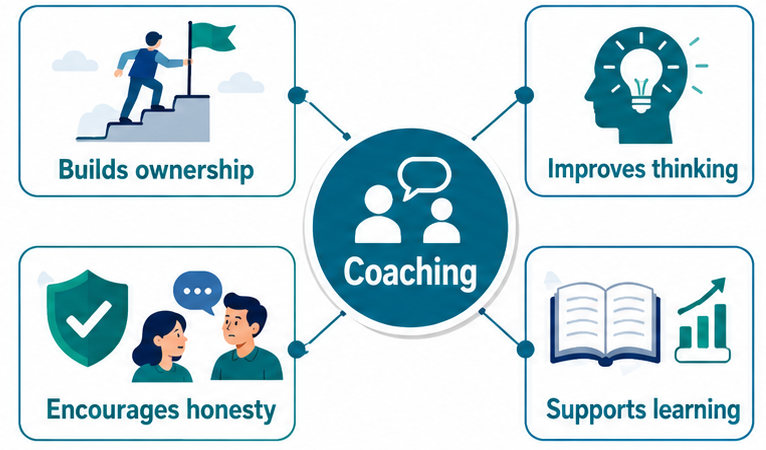
Why Coaching Is Critical to Successful OKRs Implementation
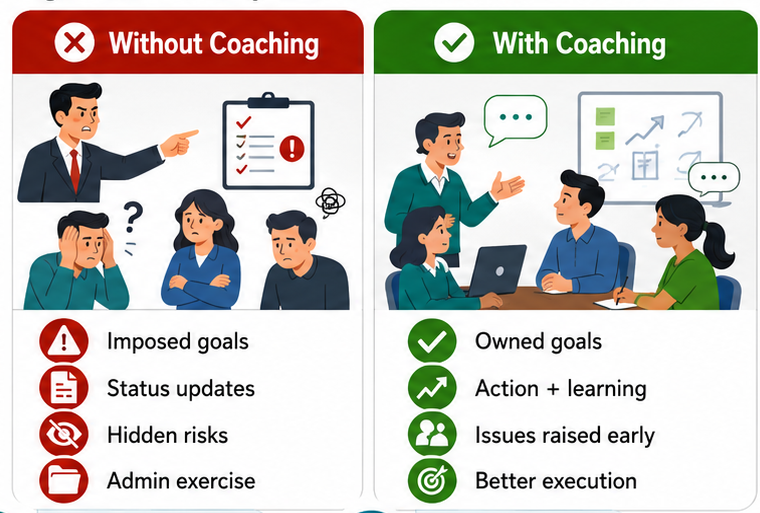
OKRs provide direction and measurement, but coaching is what helps people turn them into action. Without coaching, OKRs can become an administrative exercise in which employees update scores, attend review meetings, and explain missed targets without fundamentally improving how they work.
Successful OKRs implementation requires managers to help employees understand priorities, challenge assumptions, solve problems, learn from experience, and adapt their actions throughout the OKRs cycle. Coaching creates the conversations through which this happens.
Coaching Creates Ownership
One of the greatest risks in OKRs implementation is that goals are simply cascaded from senior leadership. Employees may understand the words in the Objectives and Key Results but feel little ownership of them. This produces compliance rather than commitment.
Corporate Objectives should provide strategic direction, but teams should still determine where they can make the greatest contribution. A manager might therefore ask:
“Given our corporate Objectives and the outcomes expected from us, what should be the most important Objective for our team to achieve this quarter?”
This question maintains alignment while giving the team an active role in shaping its priorities.
Edward Deci and Richard Ryan’s Self-Determination Theory helps explain why this matters. Their research shows that people are more motivated when they experience autonomy, feel capable of succeeding, and understand how their contribution connects to a wider purpose.
Coaching strengthens these conditions. Instead of telling employees exactly what to do, a manager might ask:
- What outcome matters most?
- What would meaningful progress look like?
- What might prevent us from succeeding?
- What support or capability do we need?
These questions do not weaken accountability. They create informed accountability by involving people in determining how results will be achieved.
Coaching Improves the Quality of Thinking
Michael Bungay Stanier argues in The Coaching Habit that managers should spend less time immediately giving advice and more time asking questions that help others think. One of his most useful questions is:
“What’s the real challenge here for you?”
This is particularly valuable during OKRs reviews because teams often discuss symptoms rather than underlying problems.
For example, a team may report that a customer-retention Key Result is behind schedule. A directive manager may demand more activity. A coaching manager investigates further. Is the real issue customer service, product quality, unclear ownership, poor data, or an unrealistic Key Result?
Coaching prevents teams from applying greater effort to the wrong problem.
John Whitmore’s GROW framework offers a simple structure for these discussions:
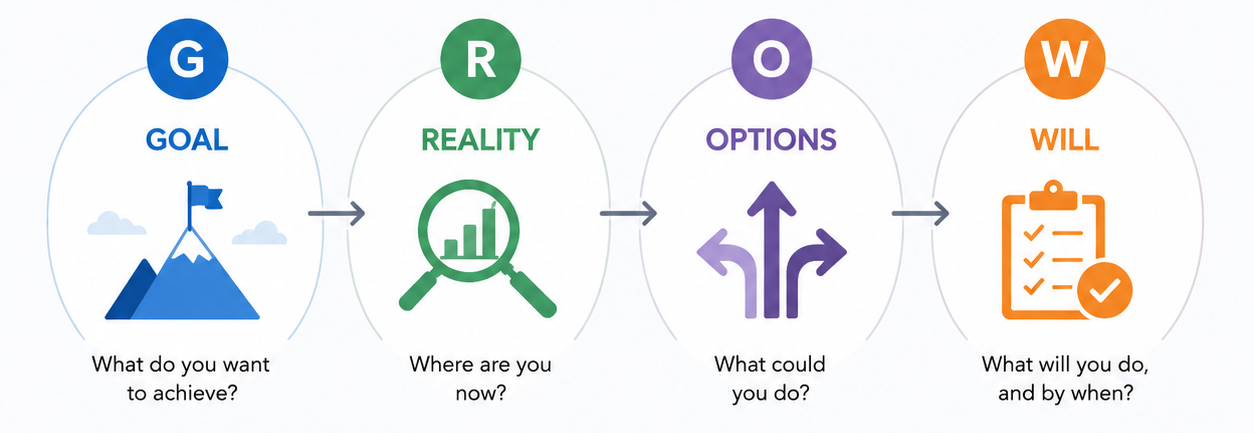
The strength of GROW lies in its simplicity. It turns an unstructured conversation into focused reflection and action.
Coaching Brings CFRs to Life
John Doerr argues that OKRs should be supported by CFRs: Conversations, Feedback, and Recognition. CFRs provide the continuous human interaction needed to keep OKRs relevant and connected to everyday work.
Conversations should explore priorities, progress, obstacles, and changing circumstances. Coaching moves these conversations beyond routine status reporting. Instead of asking only, “Are we on track?”, managers can ask, “What have we learned?” or “What is getting in the way?”
Feedback helps employees understand what is working and what needs to change. Coaching makes feedback a two-way discussion rather than a judgment delivered by the manager.
Recognition acknowledges meaningful progress, effort, collaboration, and learning. This is especially important when teams pursue ambitious Objectives that may not always be fully achieved.
Coaching therefore brings CFRs to life. It determines whether conversations create insight, whether feedback leads to improvement, and whether recognition reinforces the right behaviors.
Coaching Encourages Honest Reviews
OKRs depend on accurate and transparent information. However, employees may hide difficulties when review meetings feel like performance interrogations.
Amy Edmondson’s research on psychological safety shows that teams learn more effectively when people believe they can raise concerns, admit mistakes, and ask for help without being humiliated or punished.
A coaching manager who asks, “What have we learned?” and “What support would help?” is likely to receive more useful information than one who asks only, “Why did you miss the target?”
The first approach encourages problem-solving. The second may create defensiveness, manipulated reporting, or artificially safe goals.
Psychological safety does not mean reducing standards. It means making it possible to discuss uncomfortable facts early enough to take corrective action.
What This Means for Managers
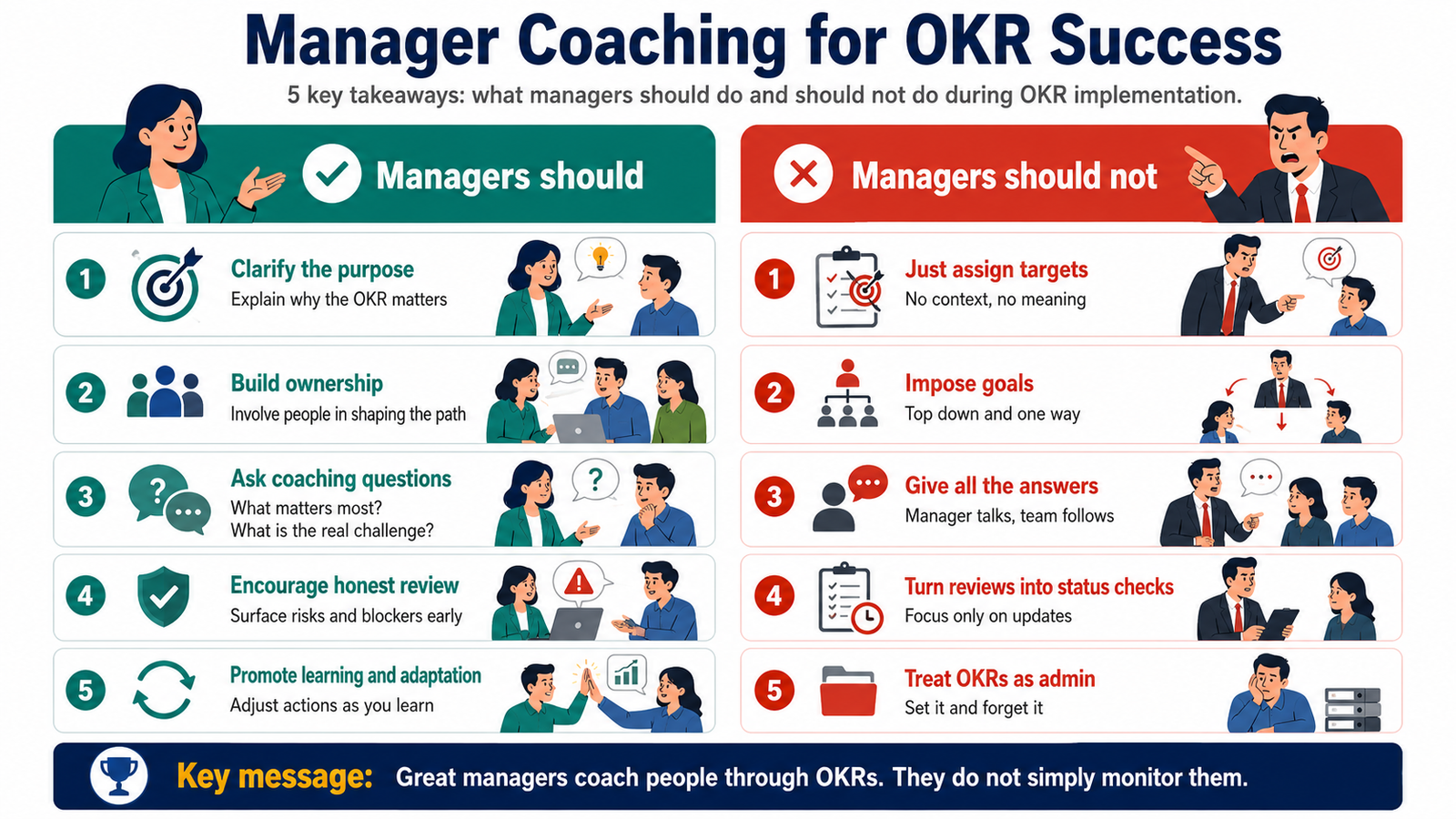
Managers implementing OKRs should not simply assign goals, monitor scores, and provide answers. They should explain why the Objectives matter, involve teams in shaping their contribution, ask questions before offering solutions, surface risks early, use CFRs to support continuous learning, and recognize progress as well as final achievement.
The most effective OKRs manager is not the person who has every answer. It is the person who helps the team understand the purpose, confront reality, develop solutions, and take responsibility for meaningful results.
 Selected References
Bungay Stanier, M. (2016). The Coaching Habit: Say Less, Ask More & Change the Way You Lead Forever. Box of Crayons Press.
Doerr, J. (2018). Measure What Matters. Portfolio.
Drucker, P. F. (1954). The Practice of Management. Harper & Brothers.
Edmondson, A. C. (1999). “Psychological Safety and Learning Behavior in Work Teams.” Administrative Science Quarterly, 44(2), 350–383.
Grove, A. S. (1983). High Output Management. Random House.
Locke, E. A., and Latham, G. P. (2002). “Building a Practically Useful Theory of Goal Setting and Task Motivation.” American Psychologist, 57(9), 705–717.
Ryan, R. M., and Deci, E. L. (2000). “Self-Determination Theory and the Facilitation of Intrinsic Motivation, Social Development, and Well-Being.” American Psychologist, 55(1), 68–78.
Whitmore, J. (2017). Coaching for Performance. Nicholas Brealey Publishing.

Ritu specializes in “Go-to-Client” strategic engagements, collaborating with top-tier technology companies featured in the Gartner Magic Quadrant. She brings a deep understanding of multiple industries and global markets, with a strong focus on market assessments, competitive analysis, uncovering white space opportunities, and monitoring disruptive technologies and industry trends.



Manish has extensive experience in Strategy Execution through Balanced Scorecard & OKRs. He has worked with prestigious organizations including McKinsey & Co., WNS Global Services, LIC Mutual Fund, and CG before founding Rescon Partners. His experience spans global organizations across the US, Europe, and Asia.